Digital Garage: Preserving the Legacy
The automotive industry is at a historic crossroads. As the shift toward electrification accelerates, the characteristic sounds of internal combustion engines—the rhythmic intake, the complex combustion cycle, and the resonant exhaust—are becoming endangered. What was once the background noise of our lives is becoming a rare, sought-after experience.
This article explores the mission of the "Digital Garage"—the effort to archive the soul of performance machines through high-fidelity audio preservation. We look at the technical challenges of recording high-decibel engines and the psychological impact of these sounds on the human brain.
The Anatomy of a Signature: V8, V10, V12
Every engine configuration has a unique "vocal cord." A V8 engine, especially one with a cross-plane crankshaft, produces the classic, low-frequency "thumping" or "burble" that defines American muscle. This is caused by the irregular interval of exhaust pulses hitting the manifold, creating a rhythmic interference pattern that our ears perceive as a growl. The firing order—typically 1-8-4-3-6-5-7-2 for a Chevy small block—creates two pulses on one bank followed by two on the other, leading to that iconic syncopated beat.
In contrast, a V10 engine—like the legendary unit in the Lexus LFA or the Porsche Carrera GT—is prized for its high-pitched, crystalline "scream." Because it has more cylinders firing per revolution and usually a higher redline, the frequency of the sound waves is much higher. It's often described as F1-esque, a sound that feels more like a musical instrument than a piece of machinery. The LFA's engine, in particular, was tuned specifically by Yamaha's music division to achieve a harmonic resonance that mimics the qualities of a fine violin.
Then there is the V12. Often considered the pinnacle of automotive engineering, a V12 is inherently balanced. The sound is a smooth, continuous "rip" or "whine." Because the firing order is so rapid and the mechanical balance is so perfect, the vibration is minimal, allowing the purely acoustic properties of the exhaust to take center stage. This is the sound of absolute luxury and power. It's not just a sound; it's a statement of mechanical perfection.
The Archivist's Duty: Why We Document
The LFG Burn Ego platform isn't just an alarm—it's a digital archive. We believe that these sounds are part of our shared cultural heritage. Just as architectural historians preserve the blueprints of great cathedrals, automotive enthusiasts must preserve the acoustic signatures of great engines. We are on a mission to document and preserve the unique voices of legendary machines before they become museum pieces.
Every recording made by our community contributes to a living library. When you record your own car's cold start using the LFG app, you aren't just making a ringtone; you're creating a high-fidelity snapshot of a mechanical moment in time. These digital fingerprints carry the legacy of internal combustion into a future that will likely be much quieter. We are documenting the evolution of mobility through sound.
Recording Techniques: Capturing the Soul
To truly capture the soul of an engine, one must understand its environment. In our "Digital Garage" series, we teach the community the art of automotive field recording. It's not just about volume; it's about clarity and "air."
Microphone Placement
If you want to capture the "induction" sound—the air being sucked into the engine—you need to record near the intake manifold. For the "exhaust" note, placement is critical. Too close to the pipe and you'll get wind distortion and phase cancelling. Too far, and you lose the low-end "grit." The "sweet spot" is usually three to five feet away, at a 45-degree angle from the tip, using a "deadcat" windscreen to minimize turbulence.
Acoustic Environment
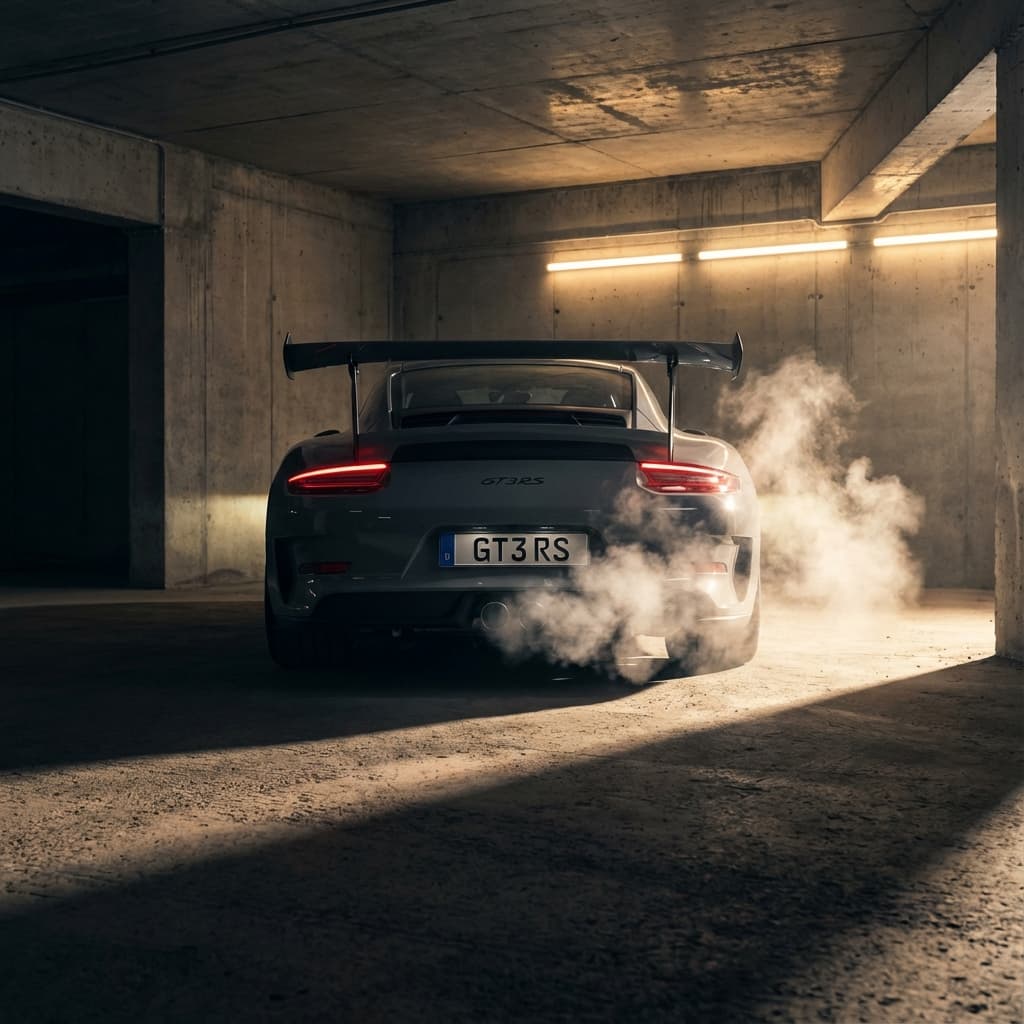
A cold start sounds massive in a concrete parking garage because of the reverb and reflection. On an open road, the sound is "drier" and more honest. Both have their place in an archive. We encourage users to record in multiple locations to create a full three-dimensional profile of their vehicle's voice. The "early morning" atmosphere, with its dense, cool air, provides the best acoustic transmission for these recordings.
The Harmonic Spectrum of High Performance
When we look at a spectrogram of a supercar engine, we see a complex web of frequencies. There's the fundamental frequency (the RPM of the engine), but above it are a series of overtones. These overtones are what give an engine its "character." A turbocharged engine often has dampened higher frequencies because the turbo turbine acts as a literal sound-absorbing barrier in the exhaust path. A naturally aspirated engine, however, provides the full, unfiltered spectrum.
Preserving these overtones is the hardest part of digital archiving. Standard compression algorithms often strip away the very frequencies that make an engine sound "alive." LFG uses lossless or high-bitrate processing to ensure that the "whistle" of a turbo spool or the "clatter" of a direct injector stays present in the mix. It's about honesty in recording.
The Psychology of Sound: Setting the Tone
Why wake up to an engine? It's about more than being a fan; it's about the psychological effect of a specific frequency. Natural alarm sounds like birds or rain are designed to wake you gently. An engine cold start, however, is designed to trigger a specific response: focus and readiness. The complex, mechanical rhythm of a firing engine signals to our brain that it's time for "ignition"—time to get moving and start the day with intention.
For the petrol-head, these sounds carry an emotional weight. They remind us of track days, early morning cruises, and the simple joy of mechanical movement. By integrating these sounds into our daily ritual through LFG Burn Ego, we turn a mundane task—waking up—into an act of passion. It's a daily reminder of why we love what we love. It's about starting the day with momentum.
Preservation as an Act of Resistance
In a world of increasing regulation and "quiet zones," maintaining the ability to enjoy automotive sound is becoming an act of resistance. The Digital Garage is our way of saying that these sounds matter. They represent human ingenuity, craftsmanship, and the thrill of the open road. By sharing and preserving these recordings, we are ensuring that the spirit of the internal combustion era lives on indefinitely.
Conclusion: The Symphony Must Go On
Preservation isn't just about sitting in a gallery; it's about integration into daily life. As we transition into a new era of mobility, let's not forget the symphony that brought us here. Whether it's the raw bark of a flat-six or the sophisticated hum of a V12, let's keep the fire burning.
LFG Burn Ego is dedicated to the preservation of automotive sound. Share your recordings with us and help build the world's most comprehensive digital garage. No ego, just soul.
Experience the Sound
LFG Burn Ego is the absolute benchmark for engine acoustics. Transform your morning ritual into a high-performance awakening.